
ChatGPT vs Gemini vs Claude: Which AI Is Best in 2026
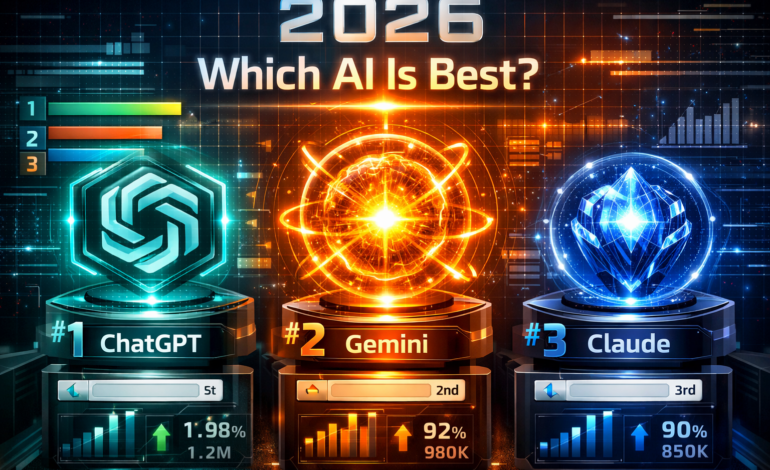

Generative AI Landscape Analysis: Assessing Top Models for Enterprise Utility in 2026
The enterprise technology environment continues its rapid evolution, predicated heavily on the maturation of large language models. Selecting the appropriate foundational model is no longer a matter of simple preference. Instead, it represents a substantial infrastructure decision carrying implications for operational efficiency, data security, and long-term scalability. We’re well past the pilot phase; organizations are now embedding these tools deep within core business processes.
Understanding the trajectory of these leading platforms—specifically focusing on the competitive dynamic of ChatGPT vs Gemini vs Claude—requires projection beyond current capabilities. It involves anticipating roadmap features and necessary compliance mechanisms expected to solidify by the year 2026. This evaluation must be rigorously focused on performance metrics relevant to return on investment.
Operational Benchmarking: Key Differentiators Among Leading LLMs
The foundational architecture of each model inevitably dictates its performance ceiling across varying tasks. Businesses require specialized output, moving past general creative generation toward repeatable, verifiable outcomes, particularly in regulated industries. Evaluating the immediate utility of ChatGPT vs Gemini vs Claude demands a structured comparison of speed, context management, and integration flexibility.
Historically, performance variability meant favoring one model exclusively for high-volume tasks. Now, the distinction is becoming less about raw capability and more about specialized fit within a multimodal operational framework. We’re observing a substantial narrowing of the competitive gap regarding basic instruction following. However, certain structural advantages persist, providing decision-makers with necessary separation points.
Context Window Management and Information Retention
One crucial metric for complex enterprise applications, such as legal document review or extensive code analysis, is the model’s capacity to retain context across massive input sets. Insufficient context handling necessitates chunking large documents, creating downstream processing inefficiency. Well, that complicates audit trails substantially.
Claude has consistently demonstrated a superior ability in managing exceptionally large context windows. This translates directly to an advantage in workflows demanding the assimilation of gigabytes of proprietary data within a single prompt sequence. Organizations dealing with financial reporting or lengthy internal knowledge bases find this capacity invaluable.
By contrast, although ChatGPT and Gemini have expanded their effective context limits, maintaining coherence at extreme lengths occasionally presents challenges. Reviewing the throughput stability, Anthropic seems to have engineered Claude specifically for deep informational tasks, sacrificing minor generalist speed for impressive retention.
Multimodal Processing and Sensor Integration
The ability of a model to process and interpret data across various formats text, image, audio, and video has become mandatory for forward-looking infrastructure planning. This isn’t just a novelty; it drives applications in retail loss prevention, automated quality control, and advanced diagnostic imaging.
Gemini, benefitting from deep integration with Google’s extensive data processing infrastructure, showcases noteworthy advancements in true multimodal understanding. It was engineered from the beginning to accept heterogeneous inputs natively, performing cross-domain analysis without requiring preliminary data conversion steps. Honestly, that streamlines workflows significantly.
ChatGPT, leveraging its partnership ecosystem, has strong modular multimodal capabilities, often facilitated through specialized APIs or plug-ins, which sometimes introduces slight latency. This approach necessitates careful orchestration. Organizations must weigh integrated native multimodal power versus the flexibility of an external, modular system.
Ecosystem Stability and API Governance
For long-term integration, a model’s stability and the governance structure surrounding its commercial API are perhaps more critical than peak performance benchmarks. Downtime, unexpected changes to pricing models, or abrupt deprecation of endpoints create serious operational risk.
OpenAI’s ChatGPT framework, despite occasional controversies, provides the most mature API ecosystem currently available. Developers appreciate the robust documentation and the sheer volume of established integrations, minimizing technical debt when building on top of the platform. This ecosystem breadth often mitigates temporary performance deficits.
Reviewing the current financial expenditure, the API costs are critical. While initial testing might be inexpensive, scaling up enterprise usage reveals significant variations in token pricing and computational overhead across all three providers. Licensing models are frequently adjusted, requiring proactive budget forecasting by IT departments.
Security Protocols and Data Residency Concerns
Data governance and stringent security protocols represent a non-negotiable threshold for enterprise adoption, particularly within financial services and healthcare. Deploying an LLM necessitates absolute assurance regarding data leakage and compliance with international data residency requirements.
Each of the three platforms ChatGPT vs Gemini vs Claude: Which AI Is Best in 2026 invests heavily in enterprise-grade security features, including Virtual Private Cloud (VPC) deployments and zero-retention policies. However, the physical location of the computational infrastructure frequently dictates feasibility for certain jurisdictions.
Organizations operating globally must prioritize providers offering granular control over data residency. We’re seeing greater demand for regionally deployed instances specifically designed to meet GDPR or CCPA requirements, impacting the competitive position of each provider in key geographic markets.
The Trajectory of Fine-Tuning and Model Specialization
Moving toward 2026, the generalized “base model” will yield operational advantage to highly specialized, fine-tuned iterations. Effective model specialization requires both large volumes of clean training data and efficient training mechanisms.
The competitive landscape demands accessible and scalable fine-tuning tools. Google’s underlying infrastructure supporting Gemini offers substantial computational resources that facilitate rapid custom model training for large corporations. This allows businesses to adapt the model quickly to highly proprietary internal terminologies and processes.
Similarly, OpenAI continues improving its fine-tuning interfaces, simplifying the process for non-data science teams to create domain-specific versions of ChatGPT. When assessing long-term utility, considering the ease with which technical teams can specialize the chosen model is paramount.
Future Resilience: Hardware Dependence and Scaling
The performance ceiling of these models remains inextricably linked to underlying semiconductor technology, specifically GPU and specialized AI accelerator architectures. Dependence on proprietary hardware ecosystems, or generalized hardware, represents a strategic risk.
Gemini’s performance often benefits substantially from deep optimization for Google’s Tensor Processing Units (TPUs). This tight integration provides exceptional scalability but can potentially introduce dependency lock-in. Conversely, models optimized for broader commercial GPU availability often afford greater deployment flexibility across various cloud providers.
Understanding this hardware dependence helps mitigate supply chain risks and ensures the chosen LLM can scale predictably during periods of peak demand. We’re seeing more organizations favor hybrid cloud strategies, requiring flexibility from the chosen model’s architecture.
The Role of Open Source Contribution in the Enterprise Stack
While these three models are inherently proprietary, their interaction with the surrounding open-source AI community influences their rate of adoption. Open source tooling built around the dominant APIs simplifies integration and accelerates development timelines.
ChatGPT, owing to its early market leadership, benefits from the most extensive set of third-party tools and community support. This external developer activity acts as a force multiplier for rapid problem resolution and feature implementation. Businesses shouldn’t overlook the value of this peripheral ecosystem support.
We must always assess capability to ensure we don’t drop the ball on the inherent capability question: ChatGPT vs Gemini vs Claude.
Frequently Asked Questions
How does latency impact enterprise user experience with these models?
Latency differences, often measured in milliseconds, become significant in high-throughput applications like real-time customer service automation or financial trading algorithms. While all three aim for low latency, the choice of context size and model endpoint location significantly influences actual response time.
Is proprietary data retained by the model providers after API calls?
Standard enterprise contracts for all three providers include zero-data-retention clauses for non-training purposes. However, specific regulatory requirements or custom deployment environments may necessitate confirmation regarding data handling procedures and regional compliance standards.
Which model offers the best cost-to-performance ratio for general tasks in 2026?
The cost-to-performance ratio constantly shifts due to continuous model optimization and pricing tier adjustments. Organizations must conduct structured parallel testing using their specific workload benchmarks. Generic benchmarks rarely reflect true operational costs for specialized business tasks.
Does reliance on a single LLM vendor pose a substantial vendor lock-in risk?
Yes, significant platform reliance inherently creates vendor lock-in. Mitigation strategies involve maintaining interoperable data pipelines and developing abstraction layers that allow for seamless switching between models, minimizing dependency on proprietary prompt engineering or data formatting conventions.
Assessing the fundamental capability shift among these leading platforms demands sustained operational testing and a pragmatic view of evolving architectural strengths, ensuring enterprises remain focused on maximizing the inherent capability question: ChatGPT vs Gemini vs Claude.